Annual Shared Meal 16th Feb 2019 at Altrincham Grammar School for Boys

Altrincham Interfaith Group Annual Shared Meal, February 16th 2019

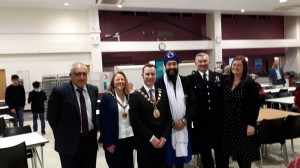
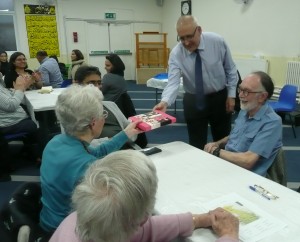
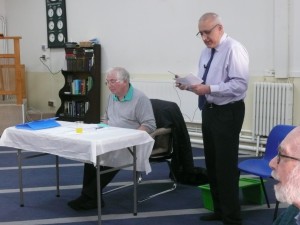
As has become the tradition now, we all met at Stamford Hall in Altrincham Grammar School for Boys on a mild evening to participate in our Annual Shared Meal. Almost 150 people attended and after a welcome drink everyone was seated and welcomed by Azhar Rasul, Chairman of Altrincham Interfaith Group. He then introduced the Worshipful the Mayor of Trafford, Councillor Tom Ross, and presented him with a cheque for his chosen charities -Trafford Mencap and the St. Ann’s Community Refugee Project.  The Mayor spoke about the excellent interfaith record in Trafford, which was the first borough in the country to welcome asylum seekers, and of the importance of sitting together and talking to each other. After prayers from Christian, Muslim, Jewish and Hindu communities, platters of delicious Kosher food including olives, pickled cucumbers, hummus, fish balls, falafel with various breads, were placed on every table for all to enjoy. Then people were invited to the serving area to be given a chicken curry with dhaal  and accompaniments, after which our guest speaker, Hani Singh, a policeman from the Sikh community and executive member of Faith Network 4 Manchester, gave his address. He was frank and honest about his re-discovery of Sikhism having investigated many other religions.  He explained the significance of his colourful attire and peppered his talk with amusing anecdotes. His address was very warmly received and then it was time for the desserts from the Christian community – a great variety of different dishes. Finally, Azhar thanked all those who had helped to make the evening such a success.


Visit to Whitworth Art Gallery 6th Sept 2018 : Textiles from the Islamic World.

Visit to Whitworth Art Gallery . A guided tour of the exhibition ‘Four Corners of One Cloth’ Textiles from the Islamic World. 

A group of members of Altrincham Interfaith Group and friends met up at Whitworth Art Gallery on the evening of September 6th for a tour of the exhibition  “Four Corners of One Cloth: Textiles from the Islamic World” given by Uthra Rajgopal, Assistant Curator of Textiles and Wallpaper.  This exhibition showcased different cultures from the Islamic world, and we started with a fragment of the Kiswa, the cloth that covers the Ka’bah, the most holy site in Islam, which is replaced each year during Hajj (pilgrimage to Mecca). Positioned in the direction of Mecca, it was in the centre of the gallery, and around it were various displays of cloths from places such as Syria, Iraq, Turkey and Yemen, as well as Uganda and Egypt. Of particular interest was a courtly dress from Iran that was covered with figures, and there was a lively discussion about representation of humans in Islamic art. Another unusual piece showed a fire hose on a piece of material -  this was considered a great asset to a town or village, hence its depiction.  We also saw how William Morris and his contempories were influenced by Islamic Art in their designs. It was a most enjoyable and informative tour and we thank Uthra for her time and expertise.

Carolyn Jones (Hon. Sec. Altrincham Interfaith Group).

YUGPURUSH

On Saturday February 3rd members of Altrincham Interfaith group were privileged to be invited to see the production of “Yugpurush” which was being presented at the Wythenshawe Forum, Manchester, for one night only.   This was timed to coincide with Hate Crime Awareness Week.

The play is subtitled Mahatma’s Mahatma,  and is about the special relationship between Shrimad Rajchandraji, and Mohandas Gandhi who later was known as Mahatma (venerable or high-souled) Gandhi. Gandhi first met Shrimad on the 6th July 1891, when he was 21 and had returned to Bombay from London having trained as a barrister. Shrimad impressed him by his amazing memory as well as his spirituality and wisdom.  They corresponded by letter when Gandhi moved to South Africa and Shrimad became his spiritual guide. Gandhi wrote of Shrimad “The more I consider his life and his writings, the more I consider him the best Indian of his times. “  Shrimad died young, aged on 33, but his writings continued to influence Gandhi, and he contemplated them again and again throughout his life.

In the play, we saw Gandhi as an old man, reminiscing about his life and friendship with Shrimad until his death by an assassin’s gun, which was truly shocking. During the play we heard many philosophical discussions between the two men – the timeless nature of the soul was stressed, and the importance of truth, compassion and non-violence for which, of course, Gandhi was renowned.  The production was very well directed, the sound quality was suberb and we found the whole experience to be very moving.

Carolyn Jones (Honorary Secretary)


The Alf Keeling memorial Lecture 2017 – “Science and Spirituality in Hinduism” by Dr Girdari Bhan.

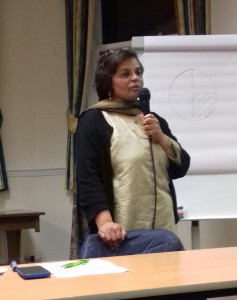
On the evening of November 9th, the hall of St Ambrose Preparatory School was filled for the occasion, with over 70 people attending the lecture which was timed to celebrate Interfaith Week 2017. Azhar Rasul, Chair of Altrincham Interfaith Group, welcomed Dr Girdari Bhan and then Poonam Kakkar, a Hindu member of the AIG committee, introduced Dr Bhan and described all he had done for interfaith, working in interfaith both locally and nationally, being co-Chair of the Interfaith Network for the UK and Patron and Ex-President of the World Hindu Council UK among many other roles.

Dr Bhan began his talk by stating how Interfaith was an opportunity to inform people about who we are. He said how there was a widespread assumption that Science and Religion were at loggerheads, and cited the debate between Creation and Evolution as an example. He pointed out that Science is based on reason and is validated by experiment and evidence, it deals with the material world. Religion is based on faith and revelation. Spirituality, however, deals with philosophical issues.

He explained how the ancient Hindu texts are packed with scientific knowledge, with no dividing line between science and spiritual knowledge. The seers held, however, that science must be validated, and withstand all challenges. The Hindu view is that the universe goes through cycles of creation and destruction, that time and space are relative, with no fixed span.

He then said how the ancient texts described many of the features of our cosmos -  the existence of atoms, the concept of planetary motion, the evolution of complex from simple life forms. He said how ancient civilizations had mastered many advanced techniques including brain surgery, metallurgy, dentistry (teeth with fillings had been found, thousands of years old),were aware of the existence of disease-producing entities (i.e. germs) and emphasised the importance of hygiene. In mathematics, the concept of zero was recognized and the ancients could calculate up to 1053.

He said that Hindus believe that knowledge comes from the Supreme Being and that we just discover things that are already there. We are also confirming ideas expressed long ago by the ancient seers.

After a brief foray through the world of astronomy and particle physics, and comparing the Old Mechanistic View with the Modern View, Dr Bhan concluded that everything is subject to the cosmic laws of nature. Humans are not the centre of creation, and he reminded us that human rights are not superior to the rights of other beings. He urged people to be open minded, and to treat knowledge with respect. There should be no conflict between science and religion.

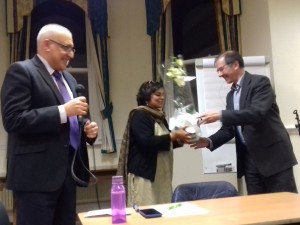
After a few questions, Azhar thanked Dr Bhan for a most interesting address and he was presented with a beautiful lily. We then mingled and chatted with drinks and biscuits.

Many thanks to all who helped to set up the hall, provide and serve the refreshments, and to St Ambrose Preparatory School for allowing us to use their facilities.

Carolyn Jones

(Hon. Sec., Altrincham Interfaith Group)