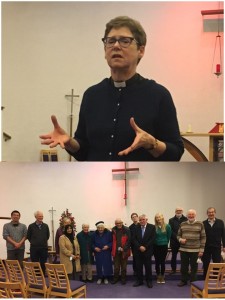
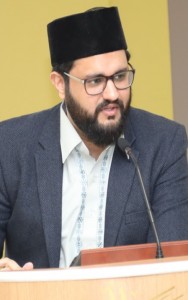
“The Fog of Srebrenica”

“The Fog of Srebrenica” film screening event – Altrincham Interfaith Group 6th July 2021

This award-winning film was screened via zoom to members of Altrincham Interfaith Group to coincide with the 26th Anniversary of the Srebrenica genocide and told the story of survivors of the only holocaust in Europe since World War Two. 8,372 mainly Muslim Bosnian men and boys were killed in one week by Serbian soldiers. The film contained personal narratives of survivors, contrasted by hauntingly beautiful landscapes and horrifying archive.

It was certainly a harrowing experience to watch, not only to hear the impact on survivors of having all their family killed but to actually see footage of men with bound hands being told to disembark from lorries at rifle-point, instructed to say their prayers and then lie face down on the ground to be shot. That is an image that I will never forget. It was dreadful to see Serbs turning on their neighbours having previously lived together peacefully, the despair of mothers who could not protect their children. Srebrenica became like a concentration camp with no food or medicine, people starving and dying in the street, while the Serbs were bombing and confiscating food before it reached them. Now, the Serbs are teaching that it never happened, trying to sweep it under the carpet, while people are still campaigning for justice.

After the film, there was a wide-ranging discussion with the Director, Samir Mehanovic.

There is a stark message here. Hatred and intolerance can flare up anywhere and flourish if left unchallenged, and we must take action against hate wherever we see it. We must speak out against prejudice to avoid such an appalling situation happening again and we must never be complacent. We must build strong communities, for no ethnic group can isolate itself and live on its own – we must learn to live together, something we at Altrincham Interfaith Group try hard to achieve.

You can watch the film at https://vimeo.com/185957639

Carolyn Jones (Hon. Sec., Altrincham Interfaith Group)

Foundation Stones Event

On the evening of March 2nd, twenty-five people joined together via zoom for turned out to be a most uplifting and stimulating event to mark International Women’s Day and also to remember victims of the Holocaust.

Elinor Chohan welcomed us and said how we must challenge prejudice to bring about change. She described the courage of the women of Sebrenica who refused to hate, and cited Emily Pankhurst as a champion of suffrage as being a person she admired. Mostly she focused on her Mother-in-Law – a remarkable women, being full of compassion and who had the gift of unconditional love. Elinor said how she taught that we should love everyone around us, no matter what their colour or culture. If everyone did that, there would be no need for Holocaust Memorial Day.

Then Angela O’Callaghan and Shakira Alam from Big Ideas explained the Foundation Stones project whereby people painted stones to dedicate to the Holocaust and other genocides. This was the aim tonight, to paint a stone and send it to the new Holocaust Memorial Centre where it would become a part of that Centre.

Three young women of different faiths then talked about women who had inspired them. First was Alexia Bastien from the Church of Jesus Christ of latter-day Saints, who talked about Raina Aboto who was the leader of a women’s organisation and had had many trials. She taught how hard times don’t define us, they refine us, and that things won’t be difficult for ever and was a source of inspiration to many.

Rumaysa Quraishi from the Altrincham and Hale Muslim Association chose Kadijah, wife of prophet Mohammed (peace be upon him), as someone who inspired her; she was strong, brave and powerful, and a wonderful wife, mother and business woman supporting Mohammed and being the first to believe him.

Finally, Shoshana Elituv, from the Shaare Hayim Sephardic synagogue spoke about her great-great Grandmother who escaped Germany to settle in Israel, taking with her some beautiful silver candlesticks so the light of the Sabbath candles should continue wherever she went. Shoshana had inherited these and showed them to us, saying we can all be the light to drive out darkness.

People were then invited to paint their stones and to share them afterwards. There were various themes including a butterfly to remember the 1.5 million children who died in the holocaust, and a stone with patches of red to represent blood and the names of all the genocides, on the reverse having a red heart to represent love. Others bore the words “Shalom,” “We will remember them,” “Give love, never forget,” and “United” with symbols of Judaism, Christianity and Islam, and more. It was a very rewarding experience.

Ruth Neal, Chairman of AIG then thanked all the speakers for their stimulating stories of women who had made a difference to their situations.

Carolyn Jones

(Hon. Sec., Altrincham Interfaith Group)

Friendship Circles

The idea of a Friendship Circle is that people of different faiths come together who meet  in one another homes, sometimes in a restaurant and in recent times meetings have taken place on Zoom. The purpose of these meetings would be to develop friendships between local people of different faiths, and to create a safe place to gain insights into one another traditions, and to discuss lifestyles and spiritual outlooks. With your participation, the Altrincham Interfaith Group will establish more of these Circles to allow more to access friendship and to have an opportunity to establish relationships with others different to themselves. A summary can be found below along with feedback from current participants.

Our Friendship Circles are running for approximately 13 years. There are 6 groups currently in the area and 8 -12 people in each group of different faiths. We meet from 6- 8 times/year and each group has a nominated coordinator. Each group has flexibility to decide frequency of meetings and topics for discussion.

Topics we have discussed in past were : Practices around births, deaths, marriages and significant religious milestone events, Festivals, Beliefs and practice, Engaging youth Parenting Poetry, Favourite book, Diet, Current affairs , international policy, Extremism, Hate crime etc

Impact : Cohesiveness and support in responding to local, national and international events, Genuine friendship Trust between communities, Sharing life experiences, Support in times of need , working on wider community cohesion

Comments from participants :

“It is only when we get to know each other as friends with bonds of trust can we tackle difficult questions”

“Ordinary community members getting to know each other on a deep and personal level”

“We have formed genuine and deep friendships and are there for one another”

“Through friendships between people of different faith group, members become less conscious of their labels and see each other as friends”

“It is very stimulating to learn about the religions and culture of others and to see them in the light of one’s own faith. To some extent the groups are spirit led and they facilitate close friendships between people of different faiths”

“The Friendship Circle has not only increased my knowledge and understanding of other religions and faiths, but it has taught me that I don’t need to be scared of being judged because of my own individual beliefs and background. Our intellectual discussions have helped me to realise that there is simply no religion that is better or worse, right or wrong. They all have the same values and are seeking the greater human good. The Friendship Circle has empowered me, I am less ignorant and more courageous.”

If you are interested in finding out more or in joining a Friendship Circle, please contact us.
Interfaith talk – “Sitting as a Latter-day Saint at the Interfaith Table: a Personal and Theological Reflection.”

On the evening of January 12th, forty eight people linked up by zoom to hear Professor James Holt, Associate Professor of Religious Education at the University of Chester, talk on “Sitting as a Latter-day Saint at the Interfaith Table: a Personal and Theological Reflection.”

This was a most interesting and stimulating address and stressed the importance of interfaith dialogue in a very positive manner. He started off by explaining that when he first went to University to study Theology his family was worried that exposure to other faiths might turn his head; that he might get “contaminated” and that people of different faiths should not meet. The main thrust of his talk, however, was spent showing how very rewarding and fulfilling interfaith engagement can be. People are not that different, he said, and can build positive relationships. Many faiths have a lot in common and share, for instance, the Golden Rule, but it is also important to recognize differences as these are important, and to be respectful of them. We can be changed by discussions with other people and should look for the strengths of other religions, not pick holes in them, and see what we can learn. We are ALL children of God, and we should not judge but love others – a message that often gets missed in our society.

Engaging with others can be transformative, and Professor Holt showed how people of other faiths have changed him and given him greater insight into various religious practices while he remained rooted in his own faith. He urged us to receive truth whatever its source, and that his truth has come through the people he has met. He also stressed that interfaith is not just about talking about things but also doing things together, and working together for the common good which is the best way to break down barriers.

There was a very lively question and answer session which involved topics such as whether it is possible to love a criminal, how the Church reaches out to the community at large, the nature of the Sunday services, the hierarchical structure of his Church, and many more. Ruth Neal, Chair of AIG, then thanked Professor Holt for explaining about his beliefs and the Church of Latter-day Saints as few of us knew much about it, and also for encouraging us in talking about his faith.

Alf Keeling Memorial Lecture, 17 November 2020

This event was timed to follow Interfaith Week and the Very Reverend Rogers Govender, Dean of Manchester Cathedral, delivered a most inspiring talk entitled “Interfaith: connection and inclusion for the common good.” Over forty people zoomed in to hear the Dean talk about how we should all celebrate diversity and difference in our cities and towns, as we are all made in the image of God. He cited Nelson Mandela as an example of someone who had a vision of the common good, someone who was able to make peace even with those who had put him in prison for 27 years. Mahatma Gandhi also had a vision of a united humanity. The Dean contrasted these great men with what has been happening in the United States where the common good is not put first and he prayed that things would calm down there swiftly.

Dean Govender suggested that Mandela’s vision of enemies living in peace together should be an example to us and that we should create conditions where all people can flourish. We should look for the well-being of everyone, celebrate difference and make connections with people outside our normal boundaries. Our Interfaith group is a good example of this and we must ensure that religion does not divide people. No one should think his or her religion is better than the others, as all the religions are connected and we are all humankind. Inclusion of others is important, regardless of gender, creed or sexuality. We should work together – as Rabbi Jonathan Sacks said, “Face to face is good but side by side is better.” The Dean challenged us by asking what we were doing to promote this vision? We each must develop harmony, respect and compassion for the homeless, the poor and for children.

Following his address there were many questions and the discussion ranged far and wide, from suggesting projects we could all do together, comparisons between life here and in South Africa (the Dean’s original home), the problems of aging congregations in churches and the need to attract young people, the evils of terrorism and whether faith schools should be banned or not. The Dean stressed the importance of promoting the common good and good values, and how we must look to the future.

It was an excellent evening and we thank the Dean most sincerely for a truly uplifting and positive experience.

Carolyn Jones (Hon. Sec., Altrincham Interfaith Group)

https://youtu.be/USk2NvCWBFA